Showing posts with label cycling. Show all posts

Monday, July 8, 2013

Northwest Tour Day 2: Old Mission Peninsula

In case you missed my last post, I am reporting on a five day bike tour I did in June. It was my first bike tour, and I had an excellent time. If you want to catch up on the background, check out Northwest Tour Day 1

I had a good first night in the tent. It was chilly (in the 40s), but the combination of my doubled up sleeping bags and my heater kept me cozy.  I was awakened by the sounds of cyclists preparing to leave early for their Day 2 routes. Our campsite mate, Mike, used to be a very hard core runner (3 hrs and change for a marathon) but had taken up cycling when his knees decided they didn’t want to run anymore. He attacked the cycling with the same intensity that he had with his running. He was one of those hundred-mile-a-day-every-day guys, and they liked to get an early start.

Leslie and I rolled out of our tents just about the time that he was rolling out on the road. Leslie and I wandered off to the breakfast tent to fuel up and discuss our route. The route choices for the day were all centered around a trip into Traverse City and out the peninsula. The 100 mile people would ride from the campground, which involved tackling the big hills leading back to the campground on the trip home, as well as several other hills on the trip itself. Something Leslie and I could both agree on was that those were not in our future.

We opted instead to drive down to the high school in Traverse City, ride up to the lighthouse, and stop for lunch at one of Leslie’s favorite spots on the way back.  I was excited because the first half of the ride would be on the Bayshore course, which I had run several times. I also had never been to the lighthouse at the end of the peninsula. It sounded like a great day.

The only fly in the great day ointment was the temperature. We had been hoping for sunny warm days for the tour, but it was chilly and somewhat breezy. We debated over what to wear, loaded up the bikes, and headed out. When we got to the high school to unload, two things were apparent right away: several other people had gone for the avoid-the-big-hills choice and we were both under-dressed. We ransacked the back of Leslie’s car looking for anything to throw on. I ended up with Leslie’s emergency long sleeve tech shirt under my cycling shirt. It saved my life because the breeze was chilly as we headed out.


I soon forgot that as I enjoyed the views on the ride, as the road wound through beautiful neighborhoods, with the occasional glimpse of the bay:


We made the turn at the top of the peninsula and passed the start line for the half marathon, which was the farthest up the peninsula I had been. It was fun but a little odd to see the area without the pre-half marathon hustle and bustle. I was in new and unchartered territory. We soon came to our first stop of the day, a really neat old general store that looked like something out of Petticoat Junction. After a short rest and a granola bar, we pressed on toward the lighthouse.

The road went inland through horse pastures, orchards, and hops farms. Thank goodness I had Leslie as a tour guide because I would have had no idea what was growing in those fields with the strange trellises. We also passed a really cool old schoolhouse. 


Now I just want to say that if you have never been past the start of the half marathon at Bayshore, you need to know that it gets a little hilly out there – not huge hills like out by the campground but enough to remind me that I had not done very much training for this 5 day endeavor. Finally we made the lighthouse at the top of the peninsula, which was also our halfway point at right around 20 miles.


As we headed back, our thoughts turned to lunch. Leslie had a favorite restaurant out there called the Jolly Pumpkin, which is famous for its artisan ales.  (Anyone who knows Leslie won’t be surprised by this little bit of information.) It was a pretty lumpy ride, but we finally made it. What a neat old place!


Over an extremely yummy lunch, Leslie told me a few ghost stories about the old building to keep me entertained. It was during this lunch stop that I made two important observations regarding cycling versus running. The first and most important is that male cyclists, in their spandex shorts, are way more fun to look at than male runners in their baggy running shorts (sorry all my male running friends). An additional benefit of cycling is the brightly colored jerseys. If you get caught checking out the guys in the tight cycling shorts, you can always follow up with “What a neat jersey? I was just trying to read what it says there on the back?”

The second important observation is that both cycling and running require Body Glide, just in different places. Yes for the first time in my cycling career, I was developing a saddle sore. And when they named it “sore,” they weren’t kidding. On top of that, about two miles into the last leg of our ride, my quads started to lock up and burn. At this point, Leslie kept pedaling away from me a bit, but I think it was mostly so that she didn’t have to listen to me whine for the last few miles of the ride. Soon, though, we were back at the high school. We loaded up the bikes and headed back to the campground. Day 2 in the books: 39 miles.

So you would think we might have gone back to the campground to rest, but no. We were off to drive the Pierce Stocking Scenic Drive at Sleeping Bear Dunes which has really spectacular scenic views. If you aren’t familiar with the dunes at Lake Michigan, you really should check this out: 


Of course we had to pose for a photo:


As we were walking down the path from the dune, we had a really cool wildlife encounter. A porcupine came out of the bushes and crossed the trail in front of us. He was just a few feet away, so like a couple of dopes we started calling it like a dog.  It did the sensible thing and waddled off into the bushes. Of course, I was all for chasing him until Leslie (always the practical one) says, “I wish I could remember how far they can shoot their quills.” Okay, maybe chasing it into the bushes is not a good idea. Still, it was pretty cool to see it so close.

As we were heading back to the campground, Leslie explained to me that a key element of touring is eating enough to keep your energy up. I am all in for that! We ended our day with a stop back in Glen Arbor for one of the best peanut butter milk shakes I have ever had.  While we ate we planned the ride for Day 3, our longest yet. It was a great end to the day! 

Related Posts: 

Monday, July 9, 2012

The Tour de France: A Runners Perspective


I know this is a running blog, but it is early July, and it is not running that is on my mind. It is Tour de France time, and for three weeks I will be obsessed with this event. I am a huge cycling fan, and as an endurance athlete have tremendous respect for the cyclists that compete in this phenomenal test of endurance. It is absolutely an amazing race!

In case you are not familiar with the Tour, let me try to put it in terms a runner might be able to relate to and that might approximate a running equivalent. 

Imagine that you entered a race --  not a single day race, but a grand race that took place over a period of 23 days, in a continuously changing set of locations so that basically your days became a whirlwind of competition, recovery in hotels, and transportation to and from race sites.

During that period imagine that you had to race every day, except for two days that were rest days.  Now imagine that most of those days were marathons or ultramarathons and that some of those were flat but others went over huge mountains. On the days when you did not have to run a marathon, you might have to do a 1 mile race or 5k or 10k at close to full speed. Oh, and to keep you honest and to keep you from lollygagging, you would have to meet a time standard that was a percent of the winner's time each day in order not to be eliminated.  If you are the competitive type also imagine that at the end of the three weeks of racing, there might only be a few seconds between you and your closest competitors.

If you can imagine what that would be like, then you might have some appreciation for what the riders go through at the Tour de France. They race continuously for three weeks across France and neighboring countries, including over the Alps and the Pyrenees, doing 3 to 4 hour races on most days (around 125 miles), but also doing time trial days that could be anywhere from the short 6.4km  (4 mi)  prologue to a longer 41 km (25.5 mi) race, which would be about the equivalent of a 10k for a running racer. It is truly amazing when you think of the level of fitness required to go out and race like this day after day.

However, that is not all that there is to the Tour.  When I was first introduced to it, the person explained that it was something like a rolling chess game, with a little soap opera thrown in. I have always felt that was an apt description. 

Part of the intrigue comes from the idea that this is both an individual and a team sport. Besides the individual awards I will talk about in a second, the Tour riders are also members of a set of teams, each starting with nine riders. If a rider on the team becomes injured and cannot complete a stage, does not start a stage, or does not complete a stage within the time limit, the team loses a member, which it does not get to replace. The Tour started with 22 teams of 9 rider each, or 198 riders. Today, with 10 days of riding completed, they are down to 178 riders, with all but one of the rest being lost to crashes and broken bones.  

Tom Danielson, one of our American cyclists out after multiple crashes


The Tour is also a contest of many different types of abilities, with major awards going each day and at the end of the race, not only to an overall winner  for the 23 days, called the "general classification" (GC) winner, (the yellow jersey everyone has heard of) but also the best mountain climber (polka dot jersey), the best sprinters ("points leader" -- the green jersey), the best young rider (up to 25 y/o -- the white jersey), the stage winner for the day, and an award each day (a special red number bib for the following day) for the most "aggressive" rider (in terms of effort and bravery spent racing -- not aggression toward other cyclists).  Each day is a drama as the various riders and teams try to either gain the lead in one of these competitions or just gain a little fleeting glory for the individual or the team by taking home a prize for the day. It is a great honor as a cyclist to get to wear one of these jerseys for a day.
The Jerseys

One of the most fascinating aspects of the racing, especially from a running standpoint, since we have nothing like this in our sport, is the teamwork aspect of the race. On each team of nine riders, there is typically one man who is marked as the team leader who may have a chance at winning the most prestigious yellow jersey for the overall winner of the Tour in the general classification. Lance Armstrong is a great example of a team leader and . Most teams also have a rider who is a sprinting specialist who is competing for the green jersey. Some teams also have a climbing specialist who is going for the polka dot jersey, but those would normally be teams without a rider strong enough to have a chance at the overall win.  On a team with a leader who is competing for the overall win, the climber's role on the team is normally a support one.

On the teams that have a rider who has the possibility of scoring high in the overall standing, the entire team works for that rider. They will ride in front of their number one guy so that he can conserve energy by drafting, sacrificing themselves and their personal goals for the possibility of his greater glory. They will also go back to the cars that follow the race to get water bottles to give to their leader so that he does not have to exert himself or go through the dangerous process of dropping back and then catching up. If the leader has a bike problem, they will wait or drop back to help their leader ride to the front, or even give their leader their own bike if needed so that the leader may continue on and not lose time.  They also surround their rider in the "peleton," that huge group of riders you see on television, to help protect him from danger of crashes.

George Hincapie, domestique extraordinaire
These support riders are called "domestiques," which means servant, but which carries none of the negative connotations associated with that word. In fact, in the cycling world, being a strong, loyal, skilled, and devoted domestique is a huge point of honor.  Strong domestiques are highly regarded. George Hincapie, the American  cyclist, is hugely respected in the cycling world for his abilities as a domestique who has helped many winners of the Tour, including Lance Armstrong and last year's winner, Cadel Evans.  Occasionally, in situations where it is possible to be done without jeopardizing the position of the overall leader on the team, a domestique will be given a chance to win the stage.

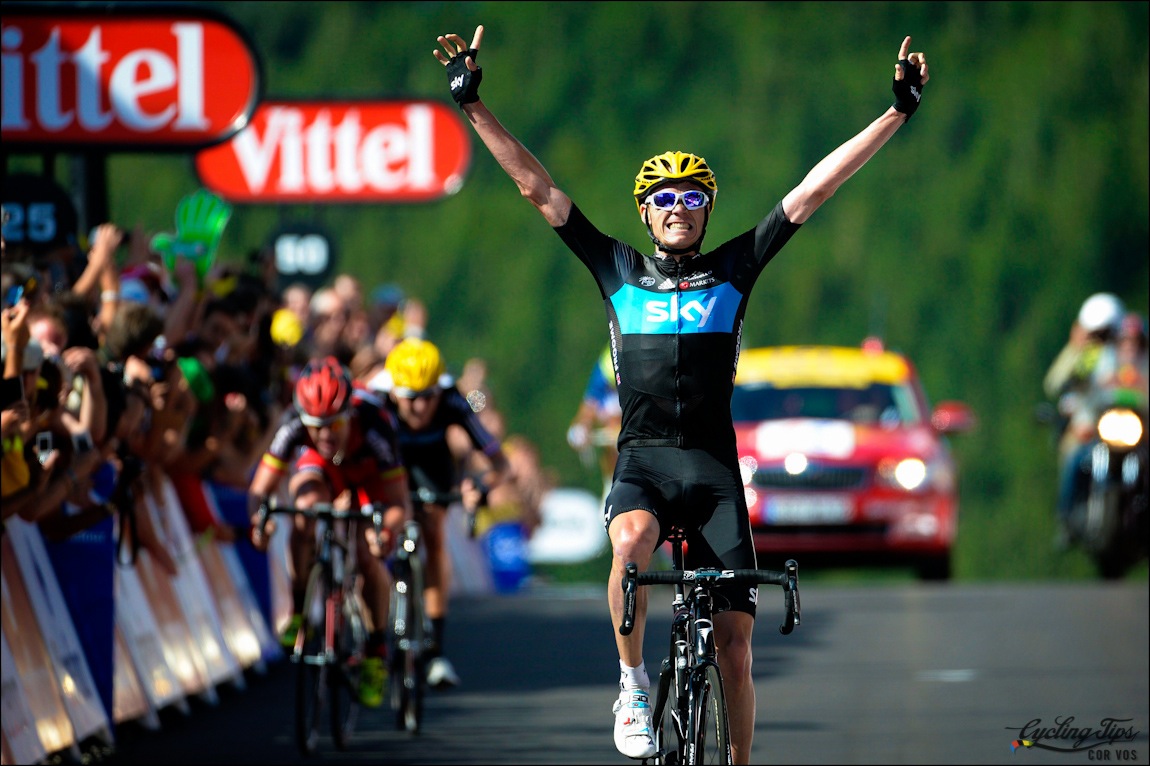
Chris Froome winning the stage.
Notice his team leader and the challenger behind
A great example of this happened already this year in the Tour when the current leader Bradley Wiggin's domestique Chris Froome led him to the top of the mountain in a serious bid to keep him in the yellow jersey by not letting the second place rider, Cadel Evans, gain the necessary ten seconds advantage that would have put him in first place. After leading Wiggins up the hill and being sure that he and Cadel would finish together, Fromme was able to sprint ahead of the two and win the stage for himself. That is the type of thing that is a huge reward for a domestique, along with knowing that they did their job well to keep their man in yellow.

This teamwork aspect of the race is fascinating to me. There is nothing like it in running, except possibly in cross country (but even there it is not so much a matter of working for someone else on the team as it is a matter of the individual efforts being combined to create the team effort).  I envy the cyclists, who get the benefits of both competing in an individual and a team effort.

Of course, just like any sport, fans have their favorite riders and their favorite teams.  My favorite team is RadioShack Nissan Trek, and my favorite rider is Fabian Cancellara, a Swiss cyclist, who is the time trial specialist on their team.  He spent most of the first week of the tour in the yellow jersey. I thought he looked pretty fabulous.
Fabian Cancellara looking great in the yellow jersey!

My second favorite cyclist is Jens Voigt, also on the RadioShack team, who is 40 years old and competing in his 15th Tour this year. He is a character for sure and the originator of my favorite mantra: "shut up legs." He is known as one of the toughest guys in the sport, willing to punish his body to the extreme to help his team. He writes a great blog called Hardly Serious.  It gives some great insight into the mind of a tough-as-nails cyclist.
Jens Voigt doing what he does.

Thanks for bearing with me on this divergence from running-related topics. I hope I have convinced you to at least check out the Tour de France if you get a chance. It is on daily on NBC Sports. It is a little confusing to be a spectator at first, but the commentators are great. (Phil Liggett is my personal favorite. I hope he never retires!)  Once you have figured it out, it becomes really fascinating. 

How about it? Any other runners who are also cycling fans out there?